
The Forex market is highly dynamic, with constant price movements driven by liquidity, trading volume, and global events. In such a fast-moving environment, traders may not always get the exact price they expect when executing trades. This phenomenon is known as forex slippage.
In this article, we will explain what is slippage in forex, why it happens, when it occurs, and how it affects different types of trades.
Slippage in Forex
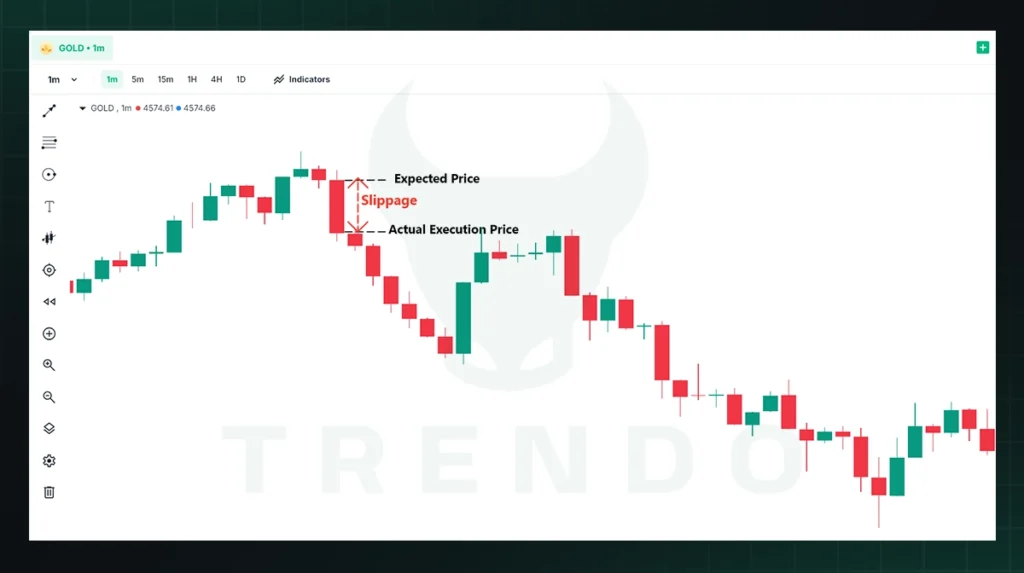
Forex slippage refers to the difference between the expected price of a trade and the actual execution price. In simple terms, slippage in forex happens when your order is filled at a different price than requested.
This usually occurs within milliseconds due to rapid market movements. When prices change quickly, even a small delay between order placement and execution can result in fx slippage.
For example, if a trader places a buy order on gold (XAUUSD) at 1825.30 but the order is executed at 1825.50, the 20-cent difference is forex slippage.
Slippage Example in Forex Trading
Example of Slippage in Gold (XAUUSD)
A trader places a Sell Stop order at $1819 while gold is trading at $1820. Due to sudden volatility, the price falls quickly and skips $1819, executing the trade at $1818.60. This is a clear case of slippage in forex, caused by fast price movement and limited liquidity at the target level.
Example of Slippage in Currency Pairs
Consider a trader opens a buy position on the EURUSD pair and set the stop loss at 1.17175. During a period of high volatility, the price suddenly drops and jumps to 1.17155, triggering your stop loss at that level. In this case, you incur a loss of 2 pips due to slippage in forex.
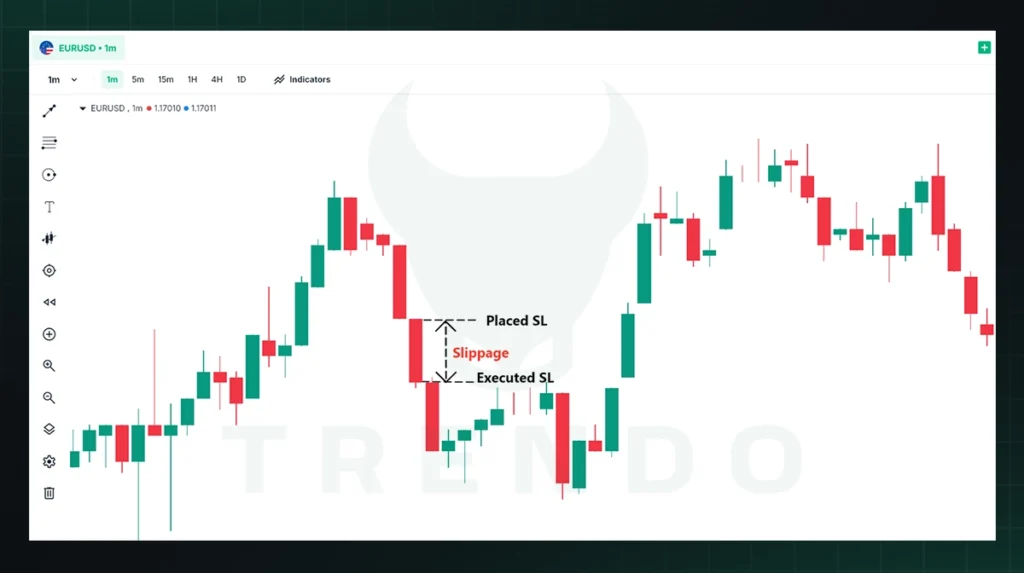
Relationship Between Spread and Slippage
While forex slippage and spread are both trading costs, they are fundamentally different. The spread is the fixed or variable difference between the bid and ask price set by the broker, whereas slippage in forex occurs when a trade is executed at a different price than expected due to market conditions.
However, there is a connection between the two. During periods of high volatility or low liquidity, spreads often widen, and at the same time, the likelihood of forex slippage increases. This means traders may face both higher spreads and unexpected execution prices simultaneously.
Understanding this relationship is essential for risk management, especially during news events or fast market movements. For a deeper comparison, read our detailed guide on slippage vs spread, where we explain how each factor impacts trading performance and costs.
Slippage in Different Order Types
Slippage in Market Orders
Market orders are executed instantly at the best available price. However, during high volatility, forex slippage is more likely because prices change rapidly. This type of fx slippage often occurs when traders manually enter positions in fast-moving markets.
Slippage in Pending Orders
Pending orders (Buy Stop, Sell Stop, Buy Limit, Sell Limit) are triggered when the price reaches a predefined level. However, if the market moves too quickly, slippage in forex may occur, and the order is filled at the next available price instead of the exact level set by the trader.
Slippage in Stop Loss and Take Profit
Stop loss and take profit orders are also vulnerable to forex slippage. During sudden market spikes or gaps, these orders may execute at worse or better prices than expected. This type of slippage forex is common during major news events or low-liquidity periods.
In what kind of trades does slippage occur?
Slippage can occur across various trading scenarios, including manual trading, conditional trading, and take profit and stop loss orders. These instances of slippage will be discussed in more detail in the subsequent sections.Slippage in manual trading (Market Execution)
The trades done manually may not activate at the points where the trader has made the transaction when the trading speed is very high, and the position is applied with a price difference. In scenarios where trading is executed manually, the orders may not be activated at the trader’s intended price points, especially when the market is moving swiftly. This results in the order being executed at a different price than planned. For example, a trader intends to sell the EURUSD currency pair at 1.12345, and as soon as he makes the sell trade, due to the high volatility of the market, the position activates with 2 pips of slip at 1.12325. It’s important to highlight that with Trendo Broker, manual trades are executed without any slippage, even during large market fluctuations, thanks to the broker’s high speed of trade execution.Slippage in conditional trading or pending order
In the Forex trading world, apart from manual trades, there are pending order trades, which are set up to execute automatically under specific conditions. These trades are categorized into two primary methods:- Stop Orders
- Limit Orders

When does slippage occur more often?
Forex slippage is more frequent under certain market conditions:
- High volatility: Rapid price changes increase the likelihood of slippage in forex
- Low liquidity: Fewer market participants can cause price gaps and fx slippage
- News releases: Economic events often trigger sharp movements and forex slippage
Slippage during Important economic news and data release time
Major economic announcements—such as interest rate decisions or employment reports—can cause sudden spikes in volatility. During these moments, forex slippage becomes more common.
For example, when US Non-Farm Payroll data is released, USD pairs may move rapidly within seconds. This creates ideal conditions for slippage forex, making trade execution less predictable.
Read More: When are important forex news announced?Slippage in weekend Gaps
The Forex market is closed on Saturdays and Sundays. However, if major events unfold during the weekend—such as the outbreak of a war or other significant geopolitical developments—these can have a profound impact on currency values. When the market reopens on Monday, these events can lead to an opening price that significantly differs from the previous close, known as a price gap. This price gap can cause slippage in conditional trades and take profit and stop loss.For instance, if gold closes at $1812 on Friday but opens at $1805 on Monday, pending orders may execute at the new price. This gap creates forex slippage, especially in stop loss or limit orders.
Read More: Types of financial markets and their trading hours